
blog
May 13, 2021
Agile meetings: Types, goals, and benefits

How many meetings are there in agile?
Agile Development came about as a response to slow and cumbersome traditional software development methodologies. Developers wanted a more nimble, user-focused model. They wanted to make changes and create software that met stakeholder requirements quickly and precisely.
Agile development focuses on the needs of the customer and end-users. The development cycle is a transparent process. The process fosters stakeholder involvement and participation at every step.
Agile developers use scrum to organize their teams and process. According to scrum.com, “the fundamental unit of Scrum is a small team of people, a Scrum Team. The Scrum Team consists of one Scrum Master, one Product Owner, and Developers.” The scrum team schedules several meetings to keep focus. Scrum uses short work intervals, called sprints, to tackle a part of a project. The team sets a finite timeline to complete the sprint.
Related post: Scrum vs. Extreme Programming (XP): What’s the difference?
Kanban gives teams a visual way to improve their workflow. Kanban originated in Japan after World War Two. Japanese managers, inspired by supermarkets, wanted a way to simplify inventory. They noticed that in a supermarket customers took only what they needed. They wanted to apply the same principle to manufacturing, keeping stock only of what they needed at the moment. Kanban aims to have inventory match actual consumption.
In software development, teams use Kanban to organize their resources and present their projects with complete transparency. They post work items on a Kanban board for all to see.
What are other tools that help teams to deliver more effectively? Find out in our "11 Agile tools each team should know about" article.
Agile methodology usually encourages six different meeting types:
1. Sprint planning meeting
The first meeting in the sprint cycle they set is the sprint planning meeting. The team decides what tasks to tackle in the sprint. They decide what backlog items to tackle. Sprint planning meetings should not take longer than one hour for each week of the sprint.
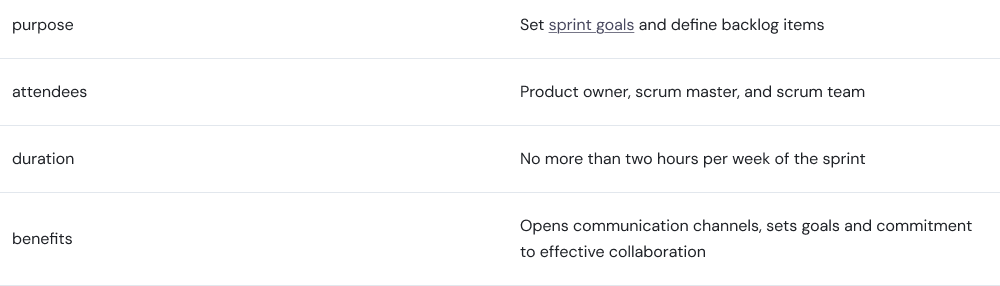
During the sprint planning meeting, the product owner explains high-priority features. They will also describe user stories the team will address during the sprint. The whole team and stakeholders should openly communicate goals and limitations.
Tips for sprint planning meetings:
- Timebox! Set a time limit for the meeting and stick to it
- Scrum teams should set realistic goals and openly communicate them to stakeholders
- Agree on what “done” looks like for the items in the sprint
- Estimate User Story Points using different approaches
2. Daily scrum meeting
Another scrum meeting happens daily. These daily scrum meetings should take very little time, they are often referred to as stand-up meetings. In these meetings the scrum team answers three questions:
- What did the team do yesterday?
- What will the team do today?
- Are there any roadblocks in the way?
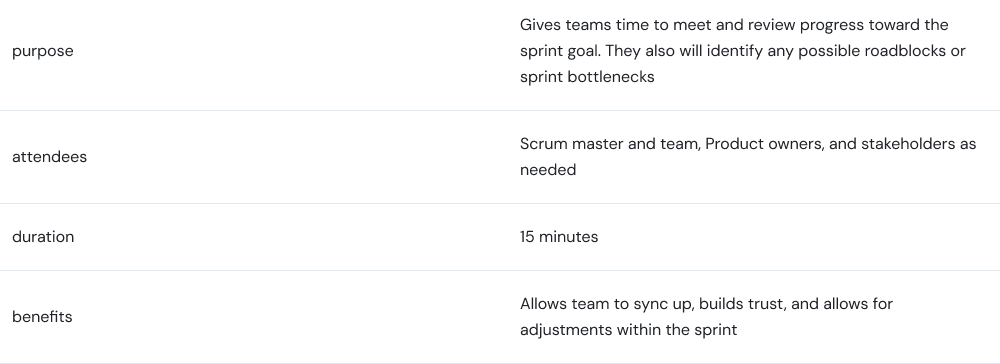
During daily scrum meetings the team gathers at the scrum board. Each team member gives a progress report. They discuss their previous day's work, what they will do for this day, and any problems. The scrum master helps the team find solutions to any problems.
Tips for daily standup meetings:
- The daily stand-up should be time-boxed
- Should be held at the same place or location and time every day
- Each member of the team should participate
3. Sprint review
Development teams using scrum also have a sprint review meeting. In the sprint review meeting, the team discusses the sprint, what went well and what they want to improve upon. They give stakeholders a view of their process. They demonstrate new features created in the sprint. They will also define the product backlog.
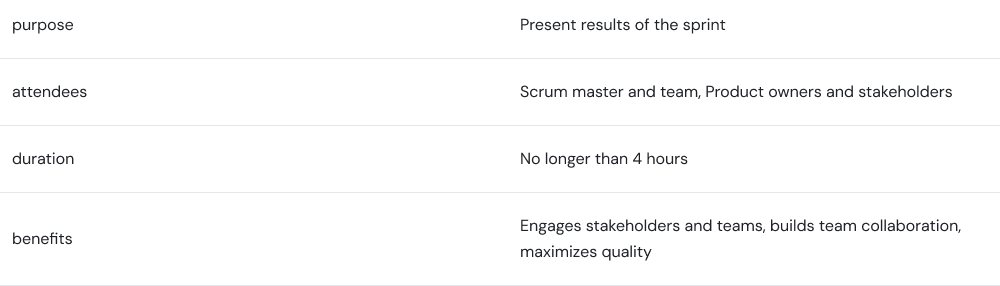
In a sprint review, the whole team and stakeholders meet to discuss the sprint goal. The team gives a presentation highlighting completed tasks, new features, and bug fixes.
Tips for a great Sprint review:
- Timebox, don't let the meeting go on past time! (Notice the theme coming up here again)
- Prepare for the meeting, but only about an hour should be necessary
- Focus on user experience and value, don't get abstract
Read our Sprint Reviews and Sprint Retrospectives: What’s the Difference? article to learn more about sprint review.
4. Backlog refining /grooming meeting
Next, the team will have a meeting to refine the backlog. This meeting gives the team a chance to review items on the backlog. They do this to ensure the backlog contains the right items. They also prioritize the backlog items, making sure items that are at the top of the backlog are ready for delivery. The team uses various backlog prioritization techniques during these meetings.
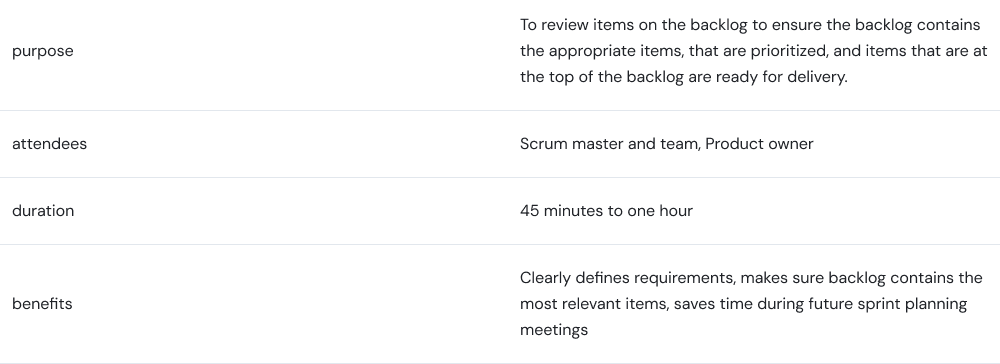
Backlog grooming meetings happen regularly. During the meeting, the team refines the user stories to remove those that are irrelevant. They will also add new stories as needed. They also correct time estimates.
Tips for backlog grooming meetings:
- Define action items
- Define risks and unknows
- Set a meeting goal
Learn more on The Importance of Backlog Grooming in Agile.
5. Sprint retrospective
After backlog grooming, the team will have a sprint retrospective. In the sprint retrospective, the team discusses the completed sprint and determines any changes to improve the next sprint.
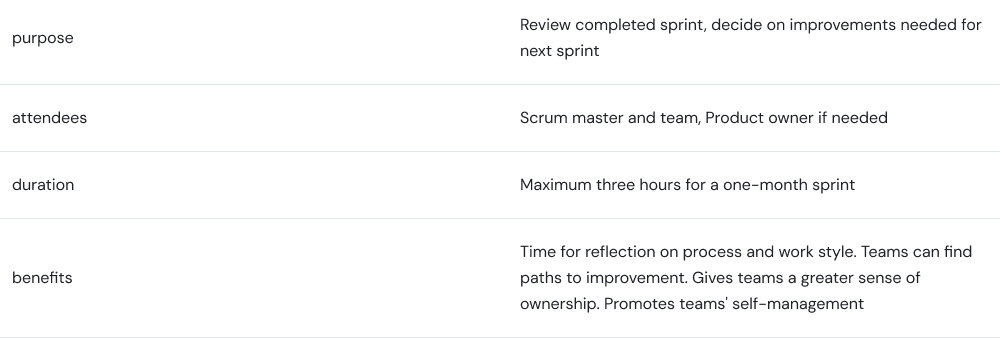
During a sprint retrospective, the team examines the completed sprint. They discuss what went well and what they need to prepare for in the next sprint. They review backlog items completed and bugs that they have fixed.
Tips for a great sprint retrospective meeting:
- Keep to the facts
- Communicate with honesty and kindness
- Keep the comments constructive
6. Release planning meeting
Teams set up release planning meetings to sketch out an overview of items they hope to accomplish. They use the meeting to set delivery schedules and long-term goals. This meeting is a great time for product owners to communicate their expectations. It’s also a great time for developers to set reasonable expectations on workflow.
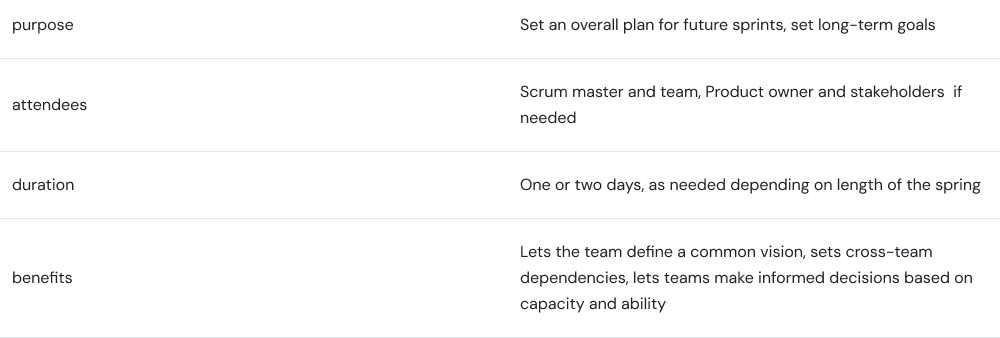
During a release planning meeting, the development team and scrum master set long-term goals. The scrum master will guide the team to make estimates on future sprints. They will make changes to their goals based on user stories and changes in a team capacity.
Read our Epic, Story, and Tasks in Agile article to understand more about how user stories affect the team's estimates on future sprints.
Tips for a great release planning meeting:
- Define what "done" looks like for the backlog items
- Stakeholders must be present and engaged
- Set the agenda in advance
- Set a limit for release deadlines
Here at Blocshop, we organize our agile teams using Scrum. Our meetings give results, using the time efficiently. Our teams understand how to build a sprint that delivers results on time and on budget. If you’d like to learn more about how Blocshop could help your business using agile, please do get in touch!
Learn more from our insights











© 2026 Blocshop s.r.o. All rights reserved.



blog
May 13, 2021
Agile meetings: Types, goals, and benefits
How many meetings are there in agile?
Agile Development came about as a response to slow and cumbersome traditional software development methodologies. Developers wanted a more nimble, user-focused model. They wanted to make changes and create software that met stakeholder requirements quickly and precisely.
Agile development focuses on the needs of the customer and end-users. The development cycle is a transparent process. The process fosters stakeholder involvement and participation at every step.
Agile developers use scrum to organize their teams and process. According to scrum.com, “the fundamental unit of Scrum is a small team of people, a Scrum Team. The Scrum Team consists of one Scrum Master, one Product Owner, and Developers.” The scrum team schedules several meetings to keep focus. Scrum uses short work intervals, called sprints, to tackle a part of a project. The team sets a finite timeline to complete the sprint.
Related post: Scrum vs. Extreme Programming (XP): What’s the difference?
Kanban gives teams a visual way to improve their workflow. Kanban originated in Japan after World War Two. Japanese managers, inspired by supermarkets, wanted a way to simplify inventory. They noticed that in a supermarket customers took only what they needed. They wanted to apply the same principle to manufacturing, keeping stock only of what they needed at the moment. Kanban aims to have inventory match actual consumption.
In software development, teams use Kanban to organize their resources and present their projects with complete transparency. They post work items on a Kanban board for all to see.
What are other tools that help teams to deliver more effectively? Find out in our "11 Agile tools each team should know about" article.
Agile methodology usually encourages six different meeting types:
1. Sprint planning meeting
The first meeting in the sprint cycle they set is the sprint planning meeting. The team decides what tasks to tackle in the sprint. They decide what backlog items to tackle. Sprint planning meetings should not take longer than one hour for each week of the sprint.
During the sprint planning meeting, the product owner explains high-priority features. They will also describe user stories the team will address during the sprint. The whole team and stakeholders should openly communicate goals and limitations.
Tips for sprint planning meetings:
- Timebox! Set a time limit for the meeting and stick to it
- Scrum teams should set realistic goals and openly communicate them to stakeholders
- Agree on what “done” looks like for the items in the sprint
- Estimate User Story Points using different approaches
2. Daily scrum meeting
Another scrum meeting happens daily. These daily scrum meetings should take very little time, they are often referred to as stand-up meetings. In these meetings the scrum team answers three questions:
- What did the team do yesterday?
- What will the team do today?
- Are there any roadblocks in the way?
During daily scrum meetings the team gathers at the scrum board. Each team member gives a progress report. They discuss their previous day's work, what they will do for this day, and any problems. The scrum master helps the team find solutions to any problems.
Tips for daily standup meetings:
- The daily stand-up should be time-boxed
- Should be held at the same place or location and time every day
- Each member of the team should participate
3. Sprint review
Development teams using scrum also have a sprint review meeting. In the sprint review meeting, the team discusses the sprint, what went well and what they want to improve upon. They give stakeholders a view of their process. They demonstrate new features created in the sprint. They will also define the product backlog.
In a sprint review, the whole team and stakeholders meet to discuss the sprint goal. The team gives a presentation highlighting completed tasks, new features, and bug fixes.
Tips for a great Sprint review:
- Timebox, don't let the meeting go on past time! (Notice the theme coming up here again)
- Prepare for the meeting, but only about an hour should be necessary
- Focus on user experience and value, don't get abstract
Read our Sprint Reviews and Sprint Retrospectives: What’s the Difference? article to learn more about sprint review.
4. Backlog refining /grooming meeting
Next, the team will have a meeting to refine the backlog. This meeting gives the team a chance to review items on the backlog. They do this to ensure the backlog contains the right items. They also prioritize the backlog items, making sure items that are at the top of the backlog are ready for delivery. The team uses various backlog prioritization techniques during these meetings.
Backlog grooming meetings happen regularly. During the meeting, the team refines the user stories to remove those that are irrelevant. They will also add new stories as needed. They also correct time estimates.
Tips for backlog grooming meetings:
- Define action items
- Define risks and unknows
- Set a meeting goal
Learn more on The Importance of Backlog Grooming in Agile.
5. Sprint retrospective
After backlog grooming, the team will have a sprint retrospective. In the sprint retrospective, the team discusses the completed sprint and determines any changes to improve the next sprint.
During a sprint retrospective, the team examines the completed sprint. They discuss what went well and what they need to prepare for in the next sprint. They review backlog items completed and bugs that they have fixed.
Tips for a great sprint retrospective meeting:
- Keep to the facts
- Communicate with honesty and kindness
- Keep the comments constructive
6. Release planning meeting
Teams set up release planning meetings to sketch out an overview of items they hope to accomplish. They use the meeting to set delivery schedules and long-term goals. This meeting is a great time for product owners to communicate their expectations. It’s also a great time for developers to set reasonable expectations on workflow.
During a release planning meeting, the development team and scrum master set long-term goals. The scrum master will guide the team to make estimates on future sprints. They will make changes to their goals based on user stories and changes in a team capacity.
Read our Epic, Story, and Tasks in Agile article to understand more about how user stories affect the team's estimates on future sprints.
Tips for a great release planning meeting:
- Define what "done" looks like for the backlog items
- Stakeholders must be present and engaged
- Set the agenda in advance
- Set a limit for release deadlines
Here at Blocshop, we organize our agile teams using Scrum. Our meetings give results, using the time efficiently. Our teams understand how to build a sprint that delivers results on time and on budget. If you’d like to learn more about how Blocshop could help your business using agile, please do get in touch!
Learn more from our insights

Talk to sales

© 2026 Blocshop s.r.o. All rights reserved.
blog
May 13, 2021
Agile meetings: Types, goals, and benefits
How many meetings are there in agile?
Agile Development came about as a response to slow and cumbersome traditional software development methodologies. Developers wanted a more nimble, user-focused model. They wanted to make changes and create software that met stakeholder requirements quickly and precisely.
Agile development focuses on the needs of the customer and end-users. The development cycle is a transparent process. The process fosters stakeholder involvement and participation at every step.
Agile developers use scrum to organize their teams and process. According to scrum.com, “the fundamental unit of Scrum is a small team of people, a Scrum Team. The Scrum Team consists of one Scrum Master, one Product Owner, and Developers.” The scrum team schedules several meetings to keep focus. Scrum uses short work intervals, called sprints, to tackle a part of a project. The team sets a finite timeline to complete the sprint.
Related post: Scrum vs. Extreme Programming (XP): What’s the difference?
Kanban gives teams a visual way to improve their workflow. Kanban originated in Japan after World War Two. Japanese managers, inspired by supermarkets, wanted a way to simplify inventory. They noticed that in a supermarket customers took only what they needed. They wanted to apply the same principle to manufacturing, keeping stock only of what they needed at the moment. Kanban aims to have inventory match actual consumption.
In software development, teams use Kanban to organize their resources and present their projects with complete transparency. They post work items on a Kanban board for all to see.
What are other tools that help teams to deliver more effectively? Find out in our "11 Agile tools each team should know about" article.
Agile methodology usually encourages six different meeting types:
1. Sprint planning meeting
The first meeting in the sprint cycle they set is the sprint planning meeting. The team decides what tasks to tackle in the sprint. They decide what backlog items to tackle. Sprint planning meetings should not take longer than one hour for each week of the sprint.
During the sprint planning meeting, the product owner explains high-priority features. They will also describe user stories the team will address during the sprint. The whole team and stakeholders should openly communicate goals and limitations.
Tips for sprint planning meetings:
- Timebox! Set a time limit for the meeting and stick to it
- Scrum teams should set realistic goals and openly communicate them to stakeholders
- Agree on what “done” looks like for the items in the sprint
- Estimate User Story Points using different approaches
2. Daily scrum meeting
Another scrum meeting happens daily. These daily scrum meetings should take very little time, they are often referred to as stand-up meetings. In these meetings the scrum team answers three questions:
- What did the team do yesterday?
- What will the team do today?
- Are there any roadblocks in the way?
During daily scrum meetings the team gathers at the scrum board. Each team member gives a progress report. They discuss their previous day's work, what they will do for this day, and any problems. The scrum master helps the team find solutions to any problems.
Tips for daily standup meetings:
- The daily stand-up should be time-boxed
- Should be held at the same place or location and time every day
- Each member of the team should participate
3. Sprint review
Development teams using scrum also have a sprint review meeting. In the sprint review meeting, the team discusses the sprint, what went well and what they want to improve upon. They give stakeholders a view of their process. They demonstrate new features created in the sprint. They will also define the product backlog.
In a sprint review, the whole team and stakeholders meet to discuss the sprint goal. The team gives a presentation highlighting completed tasks, new features, and bug fixes.
Tips for a great Sprint review:
- Timebox, don't let the meeting go on past time! (Notice the theme coming up here again)
- Prepare for the meeting, but only about an hour should be necessary
- Focus on user experience and value, don't get abstract
Read our Sprint Reviews and Sprint Retrospectives: What’s the Difference? article to learn more about sprint review.
4. Backlog refining /grooming meeting
Next, the team will have a meeting to refine the backlog. This meeting gives the team a chance to review items on the backlog. They do this to ensure the backlog contains the right items. They also prioritize the backlog items, making sure items that are at the top of the backlog are ready for delivery. The team uses various backlog prioritization techniques during these meetings.
Backlog grooming meetings happen regularly. During the meeting, the team refines the user stories to remove those that are irrelevant. They will also add new stories as needed. They also correct time estimates.
Tips for backlog grooming meetings:
- Define action items
- Define risks and unknows
- Set a meeting goal
Learn more on The Importance of Backlog Grooming in Agile.
5. Sprint retrospective
After backlog grooming, the team will have a sprint retrospective. In the sprint retrospective, the team discusses the completed sprint and determines any changes to improve the next sprint.
During a sprint retrospective, the team examines the completed sprint. They discuss what went well and what they need to prepare for in the next sprint. They review backlog items completed and bugs that they have fixed.
Tips for a great sprint retrospective meeting:
- Keep to the facts
- Communicate with honesty and kindness
- Keep the comments constructive
6. Release planning meeting
Teams set up release planning meetings to sketch out an overview of items they hope to accomplish. They use the meeting to set delivery schedules and long-term goals. This meeting is a great time for product owners to communicate their expectations. It’s also a great time for developers to set reasonable expectations on workflow.
During a release planning meeting, the development team and scrum master set long-term goals. The scrum master will guide the team to make estimates on future sprints. They will make changes to their goals based on user stories and changes in a team capacity.
Read our Epic, Story, and Tasks in Agile article to understand more about how user stories affect the team's estimates on future sprints.
Tips for a great release planning meeting:
- Define what "done" looks like for the backlog items
- Stakeholders must be present and engaged
- Set the agenda in advance
- Set a limit for release deadlines
Here at Blocshop, we organize our agile teams using Scrum. Our meetings give results, using the time efficiently. Our teams understand how to build a sprint that delivers results on time and on budget. If you’d like to learn more about how Blocshop could help your business using agile, please do get in touch!
Learn more from our insights


© 2026 Blocshop s.r.o. All rights reserved.