
blog
November 20, 2025
The ultimate CTO checklist for planning a custom software or AI project in 2026

Software and AI projects have become far more diverse than they were just a few years ago. Teams use different delivery models, products combine classic applications with data and AI features, and systems must meet stricter expectations for performance, cost control, and reliability.
In 2026, planning a successful project means understanding five essential dimensions before any code is written. These five questions define scope, architecture, delivery speed, and budget more accurately than any traditional project brief.
1. Industry context shapes the entire technical approach
Every sector comes with its own constraints. The same feature can require very different architecture depending on the field. Just a few examples:
Fintech and banking
Projects here need dependable integrations, clear audit logs, controlled deployment processes, and predictable behaviour under load.
E-commerce and retail
Customer-facing performance, conversion rates, and analytics accuracy drive technical decisions. Even small delays hurt revenue.
Education and e-learning
Platforms require modular content management, strong identity rules, and flexible user roles. Internationalization is often essential.
Healthcare and wellness
Sensitive data and strong anonymization rules demand careful data handling. Even seemingly simple tools require thoughtful backend design.
HR and internal systems
Workflow stability and long-term maintainability outweigh experimental features. Integrations with existing systems are usually critical.
Understanding the industry early prevents architectural choices that later become expensive obstacles.
2. Team structure determines delivery speed and clarity
How a team is assembled is often more predictive of success than the technology itself.
Internal team supported by an external partner
Works well when a company has its own engineers but needs reinforcement or expertise in specific areas. This model benefits from clear ownership boundaries and regular communication.
Fully external delivery partner
Sensitive data and strong anonymization rules demand careful data handling. Even seemingly simple tools require thoughtful backend design.
Flexible or hybrid approach
Useful when parts of the system require specialised knowledge or when the long-term ownership model is still evolving. Success depends on a well-defined collaboration rhythm.
Selecting the right team model early avoids delays and reduces friction during delivery.
3. Product type defines architecture and workload
Choosing the correct product category sets expectations for scale, performance, testing, and operations.
Web applications
These projects typically involve a backend API, modular frontend, reliable CI/CD, resource monitoring, and a balanced architecture that can grow without major refactoring.
Mobile apps and PWAs
Offline support, device constraints, app-store procedures, and cross-platform design patterns must be planned from the start.
APIs and integrations
Authentication, data mapping, rate control, versioning, and stable error-handling become central technical considerations.
AI-driven workflows
LLM-based features require careful cost management, efficient model routing, vector search components, monitoring, and controlled evaluation cycles. Architecture must support realistic inference costs and stable output quality.
ETL pipelines and data processing
These systems need stable schemas, dependable transformations, lineage tracking, and error recovery procedures. Data reliability becomes part of the product itself.
Enterprise business applications
Complex permission structures, long-term maintainability, internal audit requirements, and multi-module organization are common.
Correct classification avoids mismatched expectations and helps set a realistic roadmap.
4. Product maturity determines the right pace of development
Projects at different maturity levels require different team structures and delivery methods.
Early concept or idea
Work here focuses on proving feasibility, testing assumptions, validating the core workflow, and identifying the smallest build worth investing in. Rapid prototype cycles are more effective than heavy planning.
MVP with real users
The next phase is stabilising the codebase, improving performance, refining UX, and addressing shortcuts taken during the MVP phase. Analytics and error monitoring become essential.
Existing running product
At this stage, structured release cycles, optimisation work, roadmap planning, and technical audits add the most value. Progress depends on balancing new features with clean operational management.
Legacy system
Older systems require patient, methodical handling: uncovering hidden dependencies, ensuring business continuity during changes, and making a staged plan for rebuild or migration.
Aligning the delivery pace to product maturity avoids cost overruns and unnecessary rework.
5. Budget range defines realistic outcomes
Budget does not dictate quality, but it does determine the scale of what can be safely delivered.
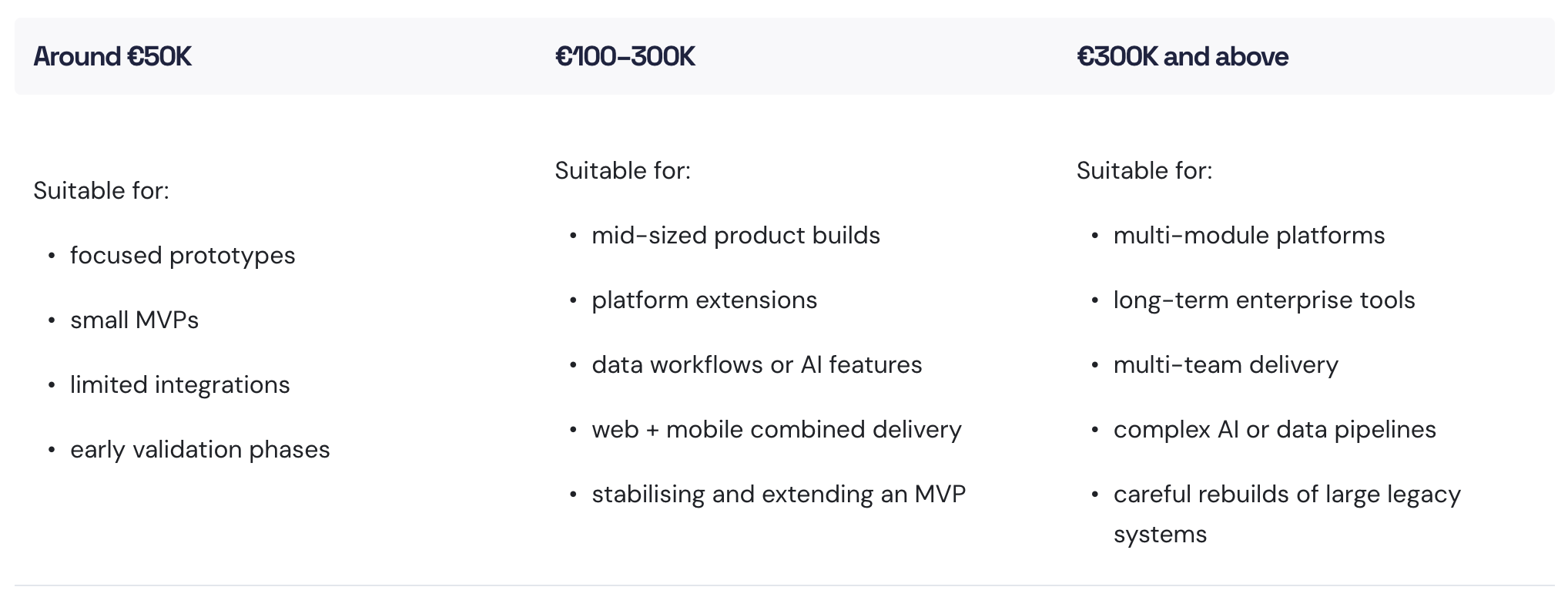
Clear ranges create shared expectations and smoother decision-making.
Why this framework matters for 2026
The software ecosystem is shifting quickly.
AI features are becoming standard components of modern apps, multi-system integrations are more common, and companies are under pressure to make technology choices that remain stable despite changing demands.
A well-structured planning process — built around industry, team structure, product type, maturity, and budget — removes uncertainty and helps companies make solid architectural decisions before writing a single line of code.
It is the simplest way to start 2026 with a project plan that is realistic, predictable, and technically sound.
Plan your own project with expert guidance
Blocshop builds custom software, AI-driven features, data workflows, and enterprise applications with clear, structured delivery models and transparent architecture decisions.
If you want to define the right scope, team structure, and roadmap for your 2026 project, we can help.
Learn more from our insights











© 2026 Blocshop s.r.o. All rights reserved.



blog
November 20, 2025
The ultimate CTO checklist for planning a custom software or AI project in 2026
Software and AI projects have become far more diverse than they were just a few years ago. Teams use different delivery models, products combine classic applications with data and AI features, and systems must meet stricter expectations for performance, cost control, and reliability.
In 2026, planning a successful project means understanding five essential dimensions before any code is written. These five questions define scope, architecture, delivery speed, and budget more accurately than any traditional project brief.
1. Industry context shapes the entire technical approach
Every sector comes with its own constraints. The same feature can require very different architecture depending on the field. Just a few examples:
Fintech and banking
Projects here need dependable integrations, clear audit logs, controlled deployment processes, and predictable behaviour under load.
E-commerce and retail
Customer-facing performance, conversion rates, and analytics accuracy drive technical decisions. Even small delays hurt revenue.
Education and e-learning
Platforms require modular content management, strong identity rules, and flexible user roles. Internationalization is often essential.
Healthcare and wellness
Sensitive data and strong anonymization rules demand careful data handling. Even seemingly simple tools require thoughtful backend design.
HR and internal systems
Workflow stability and long-term maintainability outweigh experimental features. Integrations with existing systems are usually critical.
Understanding the industry early prevents architectural choices that later become expensive obstacles.
2. Team structure determines delivery speed and clarity
How a team is assembled is often more predictive of success than the technology itself.
Internal team supported by an external partner
Works well when a company has its own engineers but needs reinforcement or expertise in specific areas. This model benefits from clear ownership boundaries and regular communication.
Fully external delivery partner
Sensitive data and strong anonymization rules demand careful data handling. Even seemingly simple tools require thoughtful backend design.
Flexible or hybrid approach
Useful when parts of the system require specialised knowledge or when the long-term ownership model is still evolving. Success depends on a well-defined collaboration rhythm.
Selecting the right team model early avoids delays and reduces friction during delivery.
3. Product type defines architecture and workload
Choosing the correct product category sets expectations for scale, performance, testing, and operations.
Web applications
These projects typically involve a backend API, modular frontend, reliable CI/CD, resource monitoring, and a balanced architecture that can grow without major refactoring.
Mobile apps and PWAs
Offline support, device constraints, app-store procedures, and cross-platform design patterns must be planned from the start.
APIs and integrations
Authentication, data mapping, rate control, versioning, and stable error-handling become central technical considerations.
AI-driven workflows
LLM-based features require careful cost management, efficient model routing, vector search components, monitoring, and controlled evaluation cycles. Architecture must support realistic inference costs and stable output quality.
ETL pipelines and data processing
These systems need stable schemas, dependable transformations, lineage tracking, and error recovery procedures. Data reliability becomes part of the product itself.
Enterprise business applications
Complex permission structures, long-term maintainability, internal audit requirements, and multi-module organization are common.
Correct classification avoids mismatched expectations and helps set a realistic roadmap.
4. Product maturity determines the right pace of development
Projects at different maturity levels require different team structures and delivery methods.
Early concept or idea
Work here focuses on proving feasibility, testing assumptions, validating the core workflow, and identifying the smallest build worth investing in. Rapid prototype cycles are more effective than heavy planning.
MVP with real users
The next phase is stabilising the codebase, improving performance, refining UX, and addressing shortcuts taken during the MVP phase. Analytics and error monitoring become essential.
Existing running product
At this stage, structured release cycles, optimisation work, roadmap planning, and technical audits add the most value. Progress depends on balancing new features with clean operational management.
Legacy system
Older systems require patient, methodical handling: uncovering hidden dependencies, ensuring business continuity during changes, and making a staged plan for rebuild or migration.
Aligning the delivery pace to product maturity avoids cost overruns and unnecessary rework.
5. Budget range defines realistic outcomes
Budget does not dictate quality, but it does determine the scale of what can be safely delivered.
Clear ranges create shared expectations and smoother decision-making.
Why this framework matters for 2026
The software ecosystem is shifting quickly.
AI features are becoming standard components of modern apps, multi-system integrations are more common, and companies are under pressure to make technology choices that remain stable despite changing demands.
A well-structured planning process — built around industry, team structure, product type, maturity, and budget — removes uncertainty and helps companies make solid architectural decisions before writing a single line of code.
It is the simplest way to start 2026 with a project plan that is realistic, predictable, and technically sound.
Plan your own project with expert guidance
Blocshop builds custom software, AI-driven features, data workflows, and enterprise applications with clear, structured delivery models and transparent architecture decisions.
If you want to define the right scope, team structure, and roadmap for your 2026 project, we can help.
Learn more from our insights

Talk to sales

© 2026 Blocshop s.r.o. All rights reserved.
blog
November 20, 2025
The ultimate CTO checklist for planning a custom software or AI project in 2026
Software and AI projects have become far more diverse than they were just a few years ago. Teams use different delivery models, products combine classic applications with data and AI features, and systems must meet stricter expectations for performance, cost control, and reliability.
In 2026, planning a successful project means understanding five essential dimensions before any code is written. These five questions define scope, architecture, delivery speed, and budget more accurately than any traditional project brief.
1. Industry context shapes the entire technical approach
Every sector comes with its own constraints. The same feature can require very different architecture depending on the field. Just a few examples:
Fintech and banking
Projects here need dependable integrations, clear audit logs, controlled deployment processes, and predictable behaviour under load.
E-commerce and retail
Customer-facing performance, conversion rates, and analytics accuracy drive technical decisions. Even small delays hurt revenue.
Education and e-learning
Platforms require modular content management, strong identity rules, and flexible user roles. Internationalization is often essential.
Healthcare and wellness
Sensitive data and strong anonymization rules demand careful data handling. Even seemingly simple tools require thoughtful backend design.
HR and internal systems
Workflow stability and long-term maintainability outweigh experimental features. Integrations with existing systems are usually critical.
Understanding the industry early prevents architectural choices that later become expensive obstacles.
2. Team structure determines delivery speed and clarity
How a team is assembled is often more predictive of success than the technology itself.
Internal team supported by an external partner
Works well when a company has its own engineers but needs reinforcement or expertise in specific areas. This model benefits from clear ownership boundaries and regular communication.
Fully external delivery partner
Sensitive data and strong anonymization rules demand careful data handling. Even seemingly simple tools require thoughtful backend design.
Flexible or hybrid approach
Useful when parts of the system require specialised knowledge or when the long-term ownership model is still evolving. Success depends on a well-defined collaboration rhythm.
Selecting the right team model early avoids delays and reduces friction during delivery.
3. Product type defines architecture and workload
Choosing the correct product category sets expectations for scale, performance, testing, and operations.
Web applications
These projects typically involve a backend API, modular frontend, reliable CI/CD, resource monitoring, and a balanced architecture that can grow without major refactoring.
Mobile apps and PWAs
Offline support, device constraints, app-store procedures, and cross-platform design patterns must be planned from the start.
APIs and integrations
Authentication, data mapping, rate control, versioning, and stable error-handling become central technical considerations.
AI-driven workflows
LLM-based features require careful cost management, efficient model routing, vector search components, monitoring, and controlled evaluation cycles. Architecture must support realistic inference costs and stable output quality.
ETL pipelines and data processing
These systems need stable schemas, dependable transformations, lineage tracking, and error recovery procedures. Data reliability becomes part of the product itself.
Enterprise business applications
Complex permission structures, long-term maintainability, internal audit requirements, and multi-module organization are common.
Correct classification avoids mismatched expectations and helps set a realistic roadmap.
4. Product maturity determines the right pace of development
Projects at different maturity levels require different team structures and delivery methods.
Early concept or idea
Work here focuses on proving feasibility, testing assumptions, validating the core workflow, and identifying the smallest build worth investing in. Rapid prototype cycles are more effective than heavy planning.
MVP with real users
The next phase is stabilising the codebase, improving performance, refining UX, and addressing shortcuts taken during the MVP phase. Analytics and error monitoring become essential.
Existing running product
At this stage, structured release cycles, optimisation work, roadmap planning, and technical audits add the most value. Progress depends on balancing new features with clean operational management.
Legacy system
Older systems require patient, methodical handling: uncovering hidden dependencies, ensuring business continuity during changes, and making a staged plan for rebuild or migration.
Aligning the delivery pace to product maturity avoids cost overruns and unnecessary rework.
5. Budget range defines realistic outcomes
Budget does not dictate quality, but it does determine the scale of what can be safely delivered.
Clear ranges create shared expectations and smoother decision-making.
Why this framework matters for 2026
The software ecosystem is shifting quickly.
AI features are becoming standard components of modern apps, multi-system integrations are more common, and companies are under pressure to make technology choices that remain stable despite changing demands.
A well-structured planning process — built around industry, team structure, product type, maturity, and budget — removes uncertainty and helps companies make solid architectural decisions before writing a single line of code.
It is the simplest way to start 2026 with a project plan that is realistic, predictable, and technically sound.
Plan your own project with expert guidance
Blocshop builds custom software, AI-driven features, data workflows, and enterprise applications with clear, structured delivery models and transparent architecture decisions.
If you want to define the right scope, team structure, and roadmap for your 2026 project, we can help.
Learn more from our insights


© 2026 Blocshop s.r.o. All rights reserved.